

When I sell my friends or online audience on reading a book I love, I don’t say
“Broooo, there is this novel, it’s a wild post-modernist southern-gothic incest story about some dude trying to find his sister, and he’s being chased by these three supernatural dudes, it’s insane, you have to read it.”
That sounds interesting, but it isn’t enough to get a modern guy/gal who reads ten books a year to get into it.
I say this instead
“Brooooo, there is this writer who grew up in backwoods Tennessee, he disavowed his father, who was the Valedictorian of Yale Law School, and was in Skull & Bones. He was a genetic genius who decided to become a writer. He lived in a pig farm shack with no money, and his wife left with their 6-month-old baby because he wouldn’t work so he could be a writer. Her leaving was so hard on him that he wrote this wild post-modernist incest story about some dude trying to find his sister and baby he left in the woods, and it’s all an allegory to his life and his guilt. It’s supernatural, and he is the master of Southern Gothic horror. It’s like Faulkner and Flannery O’Connor on steroids. You have to read it. “
I am one of the most hype and effective literary promoters in the world, on my YouTube channel, Write Conscious, I’ve helped tens of thousands of people start reading liteary fiction for the first time, I’ve been convincing my friends to read hard books for 18 years, and I motivated students for eight years in the classroom as an English to read classics in one of the worst states for education in the country.
I know how to pitch books.
I am also a champion for the literary renaissance. I believe that the countless modern writers, neglected by academia and publishing for decades, can push real literature back into the minds of the masses worldwide.
That renaissance could happen right now.
Hundreds of millions of classic novels are read each year, and those works aren’t easy BookTok entertainment. Contrary to the beliefs of lit/logic bros and the black-pillers, there are nation-sized groups of readers who aren’t brain rotters who want to believe in modern authors again, and have the ability to understand complex fiction/poetry.
There are more modern writers than ever who are great stylists and know how to write compelling stories/poems that could contend with most great bestselling classics.
We have scalable distribution channels for our writing, including Substack and other social media platforms. We can use print-on-demand services to send our books all around the world and get covers and formatting done cheaply, or do it ourselves. E-readers and audiobooks make it even easier to get work in front of readers.
Other artistic mediums have elevated countless independent artists to stardom and shown that it’s possible not just to have a few breakout stars (literature currently has zero self-made independent literary celebrities), but thousands who create entire movements.
So what’s missing?
Living writers. Writers on Substack are straight-up dead.
No energy. No identity. No message.
My friends (and most readers) read classics because the authors and their message have been mythologized and elevated.
Going back to my earlier example, what type of pitch can I give my smart, literate friends about Substack writers?
“Brooooo, there is this writer on an app named Substack, yeah, you’ll have to download it and make an account. I don’t know who he is, he has a pen name and anon profile picture, but he wrote this really cool story about a depressed guy walking around Portland. Oh yeah, he just finished a 30,000-word serialized tragic coming-of-age novel about some kid who can’t tap into his emotions. He also hates David Foster Wallace and wrote an awesome takedown piece about him. He is such a good writer.”
What are the chances my friend will download the app and check this writer out for FREE? One in a million.
Most writers who attach their identity and a photo to their account would have a similar-sounding pitch.
We are good enough at writing. That isn’t the problem.
The real problem is that Substack writers have collectively fallen for the greatest literary psyop ever pulled, and we've started writing only for writers and hardcore readers.
We stopped believing writing is meant to be transformative and stand for something. All the rich nihilist kids who took over literature because of insane grant, academic, and publishing fluff money programmed us to want to be like them. Their disconnected writing (some of which were hallmark pieces of literature for hardcore readers) is the reason my friends and everyone else don’t believe in modern literature anymore.
Now the money is gone, but we still are writing like it’s the nepotistic golden days of literature.
The best example of modern writers' disconnection is their belief that they’re too smart, too artistic, and too humble to self-mythologize. Only cringe influencers like Ian Cattanach do that.
Yet they’re perfectly fine with institutional mythologizing of writers through publishing houses and academia.
What’s INSANE is that even the pen name fiction writers of Substack refuse to self-mythologize when they could make up whatever shit they wanted about themselves.
Don’t believe me?
The earlier example I gave was about Cormac McCarthy’s second novel, Outer Dark.
He had it published with Random House, and it sold only 2,000 copies. But they never mentioned McCarthy’s backstory or anything about him while marketing his first five novels, and that’s why all of them flopped.
It wasn’t from a lack of good writing, as those novels included Suttree and Blood Meridian, which are the greatest Southern Gothic and Western novels of all time.
It wasn’t because McCarthy was unwilling to have someone mythologize him. As in 1987, McCarthy’s editor, Albert Erskine, retired, and McCarthy switched to Alfred Knopf. Their marketing team built a new mythology around McCarthy that was VERY exaggerated, introducing the reclusive romantic cowboy (who didn’t ride horses) to the masses in Esquire, The New York Times, and other major publications.
What happened then? McCarthy’s novel All The Pretty Horses sold 200,000 copies in a few months, and over the next thirty years, McCarthy’s works sold tens of millions of copies. If you asked most people who they thought McCarthy was before McCarthy Gate in 2024, they would tell you the mythology his publishers invented back in 1992. Oh yeah, the purpose of his life and main message outside of writing with the Santa Fe Institute, reflected within every piece of his writing. There were no random fuck around pieces.
One message, one mythology, all backed by great writing.
I’m not sitting here and telling you to lie or make stuff up. But right now, almost every Substack fiction writer has no message, no mythology, and a bunch of random, unconnected stories and ideas. Oh yeah, plus a few takedown pieces against dead authors.
Our writing is the perfect reflection of the fractured, chaotic, and flattened modern soul we love to rant about.
Big publishing is dead. No one out there will mythologize you anymore. If you want to have a bigger audience than the random lit bros on Substack, you’re going to have to do it yourself.
It will be messy, and it will take years for you to really dial it in.
But it’s the only path out of the Substack writing circle jerk, so you can actually start activating non-readers with your work. There aren’t enough lit bros and writers left to only rely on them. You need people like my friends. The people who read a dozen books a year, and would be willing to give some new literary authors a try. FYI, when we talk about books, they talk about how they felt when reading the book, how it made them cry, or rethink their reality, not how good the writing or style was.
The best way to start is not to lie, but to magnify the parts of yourself and your story that most reflect in your transformative writing. And if you are part of the majority of writers on Substack who are not trying to write transformative writing, what are you doing? Who are you writing for?
When someone compared me to another literary influencer yesterday, this was one of my supporters’ responses.
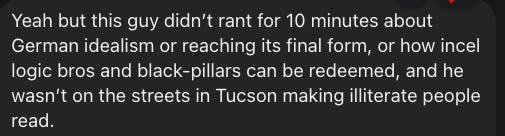
It’s bigger than the words on the page.
When you become bigger than the words on the page and align your message, nothing can stop you or your work.
The more haters I have, the more Substack logic bros try to take me down, the bigger my mythology will grow when people pitch me to their friends.
“Broooo, there is this writer, he is changing the entire world of literature, everyone is coming after him, but he is like us, he doesn’t give a fuck, and he just wrote this crazy piece in his literary magazine…”
A large part of it comes from the irrational fear of rejection. We as a society have become petrified of being looked at in any semi negative light even over things that are so small they shouldn’t even be a concern.
Selling and mythologizing yourself is a stage of transformation that many people are not at yet, but writers need to be. Appealing to people who don’t normally read is a great obstacle but could be a very fun challenge. Yet trying to be a piece of that collective transformation takes more work and flexibility, so it’s understandable why most find it easier to just write for similar nerds with similar interests. Hence, the Substack circle jerking. Which has been very noticeable.